
Reviewed 14 September 2026 by the Persian Touring editorial team
A Responsible 7-Day Iran Itinerary
Use a focused Tehran, Kashan, Isfahan and Yazd framework, then verify every connection and condition before acting.
A realistic 7-day Iran itinerary cannot give every classic city equal time. This page prioritizes a compact cultural corridor through Tehran, Kashan, Isfahan and Yazd. It gives two nights to the main bases, limits repeated backtracking, and treats the final connection as a decision that must be solved before reservations are requested.
This is an editorial planning framework, not a currently operating tour. It does not confirm transport, rooms, attraction access, entry permission, guide availability or safety. Persian Touring can review the route against a traveller’s dates, passport, pace and mobility needs, but the first response is not a booking or approval.
Who this seven-day route fits
This version is designed for a first visit with seven usable days on the ground, an interest in architecture and urban history, and comfort with three intercity moves. It works best when Tehran is the arrival point and the onward departure has been confirmed independently. It is not a claim that all four cities are currently reachable or appropriate.
Choose fewer bases if arrival day will be tiring, if the traveller needs frequent rest, or if stairs and uneven surfaces are a concern. Choose a different route if Shiraz and Persepolis are the central reason for the journey. Adding them to this framework usually converts a focused week into a chain of transfers.
| Planning need | This route’s answer | When to simplify |
|---|---|---|
| First-night recovery | Tehran receives the arrival night and one full day. | Add another Tehran night if arrival timing or fatigue is uncertain. |
| A smaller-city contrast | Kashan is one deliberate overnight, not a hurried roadside checklist. | Skip it if packing and hotel changes create too much load. |
| Depth in a major heritage city | Isfahan receives two nights and a full city day. | Use Isfahan as the final base if Yazd would make departure fragile. |
| Desert-city urban context | Yazd receives the final two nights, subject to onward planning. | Remove Yazd if the verified departure requires a risky backtrack. |
The route at a glance
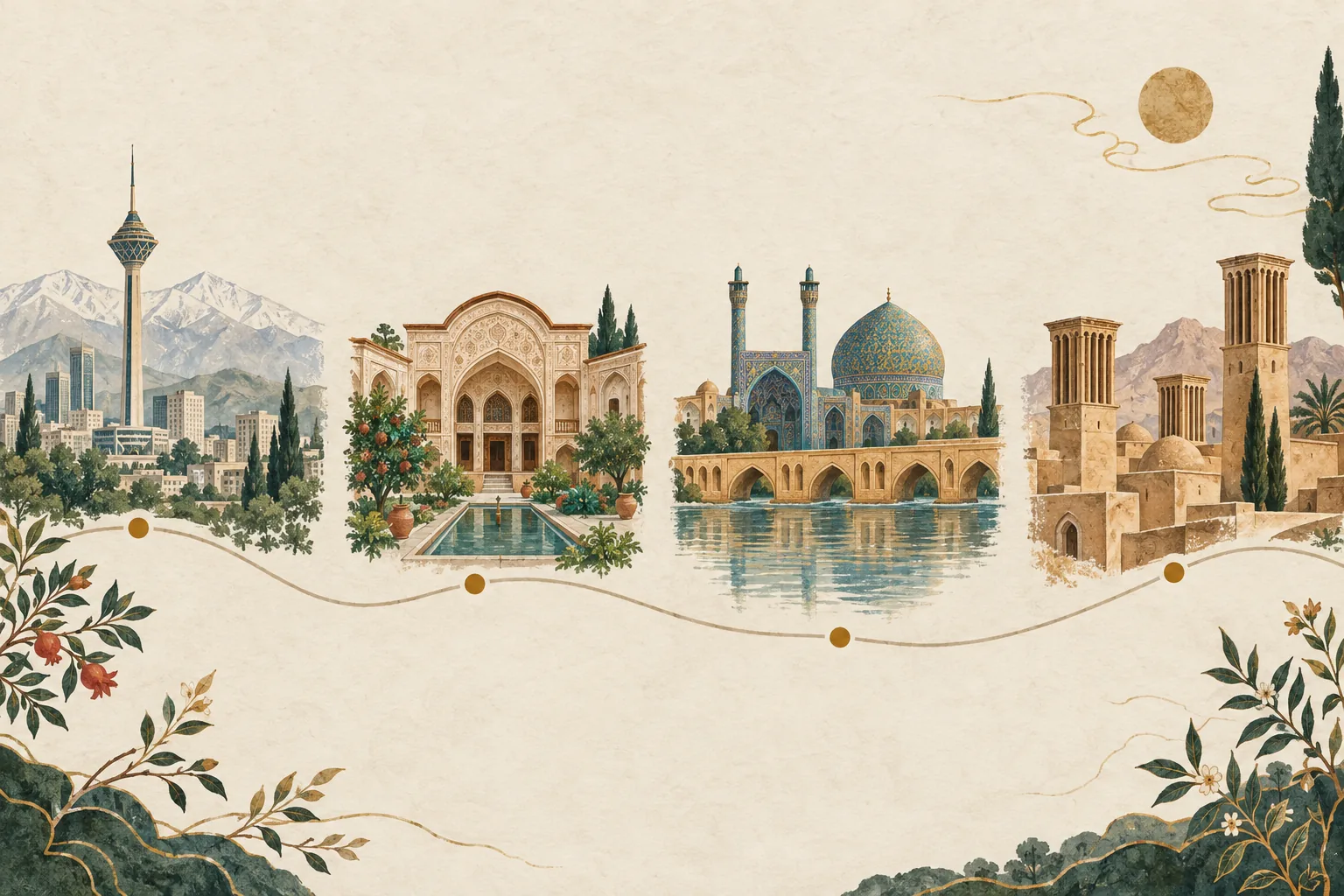
The core sequence is Tehran for days 1 and 2, Kashan on day 3, Isfahan on days 4 and 5, and Yazd on days 6 and 7. This is a planning order rather than a timetable. Road, rail and air operations can change, so each leg needs a named option, a current date check and a fallback.
UNESCO’s official Iran list records Golestan Palace in Tehran, Meidan Emam and the Jame Mosque in Isfahan, the Historic City of Yazd, and several components of the Persian Garden. That status helps identify cultural themes, but it does not confirm opening hours or visitor access. Consult the UNESCO World Heritage Convention’s Iran page, then verify the venue itself.
Before choosing this week over the other route lengths, compare Persian Touring’s Iran itineraries planning guide. It explains why seven days benefits from a narrow scope and why a longer trip should buy depth rather than simply more stops.
A day-by-day 7-day Iran itinerary
Day 1: arrive in Tehran and protect recovery time
Treat the first day as arrival, orientation and verification. Confirm that the accommodation address, transfer contact and next day’s essential plan match the written information you hold. Solve immediate money, connectivity, medication and meal needs before attempting a long list of sights.
If arrival leaves useful time, choose one nearby walk or public space rather than crossing Tehran. Keep the first evening flexible because airport operations, immigration, baggage, traffic and fatigue can all change the day. Do not attach an unverified intercity connection to an international arrival.
Day 2: build one coherent Tehran cultural day
Select one geographic and thematic cluster. A national-history focus might begin with a museum and pair it with a nearby historic district. A Qajar-era focus might consider Golestan Palace and adjacent urban fabric if current access is confirmed. Contemporary interests could lead elsewhere. The useful planning move is to choose one anchor, one nearby alternative and a stopping time.
Check the current status of each venue shortly before visiting. Security measures, public events, restoration, holidays and air quality can affect access. Persian Touring’s Iran travel-guide hub can help compare city themes, but official or venue information should decide the day’s operations.
Day 3: travel to Kashan and slow the scale
Move south only after the actual transport and pickup point are confirmed. Kashan is valuable because its historic houses, gardens, bazaar fabric and courtyard traditions offer a different spatial experience from Tehran. Pick one or two priorities rather than trying to enter every recorded property.
An overnight can make the stop more meaningful, but it also adds a room change. Historic accommodation may include steps, low thresholds, internal courtyards and rooms that differ from one another. Use the traditional hotels in Iran guide to frame access and room questions, then request live details.
Day 4: continue to Isfahan and orient locally
Keep this as a transfer and orientation day. After arrival, choose a manageable walk near the confirmed accommodation rather than committing to a cross-city program. Record where the next day’s anchor places sit, how much walking is realistic, and what can substitute if access changes.
Accommodation location has a direct effect on the route. A beautiful property far from the planned areas may add repeated traffic and walking load. The hotels in Iran planning guide and hotel-request checklist separate recorded property information from live confirmation.
Day 5: give Isfahan one full, focused day
Use one full day to understand a connected layer of Isfahan rather than collecting distant landmarks. A Safavid civic-architecture theme may centre on Meidan Emam and its surrounding monuments. Another day design could connect Armenian heritage, neighbourhood life, craft traditions or garden history. Decide which story matters before setting the sequence.
Historic squares, bazaars, mosques, palaces and bridges have different access, etiquette and physical demands. Ask about current opening, photography rules, religious use, stairs, seating and vehicle drop-off points. Leave an unallocated block for rest or a nearby alternative.
Day 6: move to Yazd with the final connection in view
Confirm both this intercity leg and the end-of-trip plan before leaving Isfahan. On arrival in Yazd, make the first experience a slow orientation through an appropriate section of the historic fabric, subject to current local guidance. The city’s windcatchers, courtyards, lanes and earthen architecture deserve observation rather than a hurried set of photo stops.
Uneven lanes, rooftops, steep steps and heat exposure can matter. Ask which parts of the proposed route are suitable for the individual, where shade or seating is available, and how the day can be shortened. Do not assume that a “heritage” property or walking route is step-free.
Day 7: choose depth, a buffer or departure
If the verified onward plan allows a full day, select one Yazd theme and keep the route compact. Possibilities include historic urban form, water management, garden design or religious heritage, but every venue and conduct requirement needs current checking. An excursion outside the city should remain optional until vehicle, route, weather, communications and return arrangements are documented.
If day 7 contains an international departure or a long return, sightseeing is secondary. Build the buffer around the confirmed airport, border or station. Do not rely on a same-day unverified domestic connection. If the only workable plan requires returning toward Tehran, remove Yazd or add a night instead of hiding the backtrack inside the final day.
What to change, not add
A short itinerary improves when priorities replace one another. If Shiraz and Persepolis are essential, design a southern week and remove Yazd or Kashan rather than adding both. If museums and contemporary city life matter most, add time to Tehran and finish in Isfahan. If slow travel and access are priorities, use two bases and plan carefully chosen day trips only after conditions are confirmed.
Families may need predictable meal periods and shorter cultural blocks. Photographers may prefer fewer sites at better times of day. Older travellers and anyone with mobility requirements may benefit from fewer room changes, precise bathroom and lift information, and a vehicle plan that states actual walking distances. A private route is useful only when it reflects those constraints.
For a broader planning sequence, start with the responsible travel-to-Iran guide. Passport-specific questions should go through the Iran tourist visa assistance page; no itinerary creates a right to enter or promises approval.
Seven checks before confirming the route
- Advice and insurance: save the current official advice for every nationality and ask the insurer how that advice affects cover.
- Entry route: verify the rules for every passport, including any nationality-specific guide or itinerary requirements.
- Arrival and exit: identify the actual usable points and protect the final international connection with a conservative buffer.
- Intercity legs: record date, operator or responsible party, departure point, luggage needs, pickup contact and fallback for each move.
- Rooms: confirm property, address, room type, occupancy, access, included services, total amount, payment method, cancellation terms and confirmation contact.
- Daily access: check opening days, tickets, photography, dress or conduct, restoration and mobility conditions for essential places.
- Contingencies: document money, communication, medication and emergency plans suitable for the traveller.
Keep the answers in one dated document and mark which items are assumptions. Reconfirm the most time-sensitive details shortly before travel. An old timetable, screenshot or blog post shows what was once displayed; it does not prove that a service operates now.
Request a seven-day itinerary review
Send travel dates, passport nationality for each traveller, intended arrival and departure points, party size and ages, room needs, walking comfort, accessibility requirements, key interests, essential places, places you are willing to skip and preferred pace. Mention any fixed commitment that cannot move.
Persian Touring can review the sequence, identify information gaps and explain what requires live checking. The initial response does not reserve rooms, issue a visa, confirm transport or guarantee access. Compare private Iran tour planning, then request an itinerary review. Read the booking terms and privacy information before submitting personal details.
Sources and review note
This page was reviewed on 14 September 2026. Current security and disruption statements were checked against GOV.UK, Smartraveller and the U.S. Department of State. World Heritage references were checked against UNESCO’s official Iran record. The route itself is Persian Touring editorial planning, not an operating schedule. Transport, accommodation, attraction, entry and departure details require a separate current check for the traveller’s dates.