
Reviewed 11 September 2026 by the Persian Touring editorial team
Iran Itineraries: 7, 10 & 14 Days
Choose a focused seven, ten or fourteen-day route, then verify every service, entry rule and connection for your dates.
The most workable first-time Iran itinerary is usually a focused cultural route, not a race across the country. Seven days suits two or three bases, ten days can connect the classic central cities, and fourteen days gives you room for slower visits or one carefully chosen extension. The route ideas below are planning frameworks, not confirmed tours: transport, accommodation, attraction access, entry permission and operating conditions must all be checked for your dates.
Persian Touring can review a proposed sequence against your dates, passport, pace, mobility needs and current availability. A request is not an instant booking, visa approval or guarantee that every service will operate.
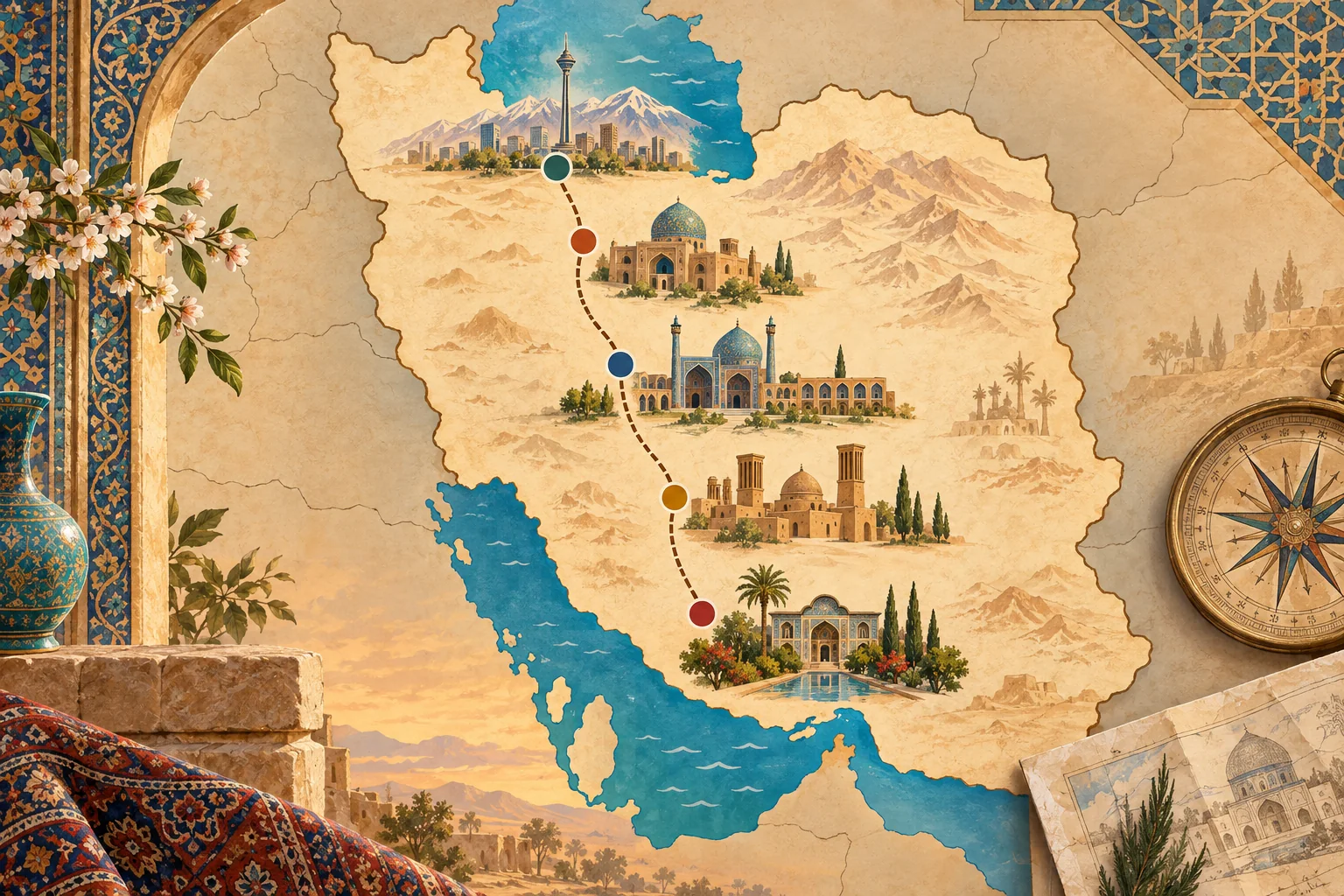
Which Iran itinerary length should you choose?
Start with usable days on the ground. Arrival evening and departure morning may not be sightseeing days, and an international connection should not depend on an unverified same-day domestic service. Count nights, identify the airport or border you expect to use, and leave recovery time after long transfers.
| Time available | Sensible scope | Good fit | Main compromise |
|---|---|---|---|
| 7 days | Two major cities plus one smaller stop, or three bases at a brisk pace | Travellers with one clear theme and limited time | Little room for disruption, remote areas or repeated one-night stays |
| 10 days | Tehran, Kashan, Isfahan, Yazd and Shiraz as a one-way cultural corridor | First visits focused on architecture, history and city life | Still requires disciplined choices; not every city needs every headline sight |
| 14 days | The classic corridor at a slower pace, or a focused regional extension | Travellers who value depth, rest and optionality | An extension adds transport and verification work |
The five-city Tehran–Kashan–Isfahan–Yazd–Shiraz sequence appears often because it moves broadly in one direction and connects several historically significant places. UNESCO’s official Iran page is a useful starting point for checking World Heritage status and property records, but inclusion on a list does not confirm that a site is open on your date. Always verify operating days, access rules and local conditions separately.
A focused seven-day Iran itinerary
A seven-day plan should have a strong point of view. Trying to give Tehran, Kashan, Isfahan, Yazd and Shiraz equal time produces too many transfers and too little experience. A more resilient framework uses Tehran, Kashan and Isfahan, with the final departure plan checked before anything is reserved.
Days 1–2: Tehran for arrival and orientation
Use the first day to recover from arrival, confirm money and connectivity arrangements, and learn how your accommodation is positioned relative to the places you care about. For a first cultural day, choose one museum or palace area, one neighbourhood or bazaar walk, and enough unscheduled time to deal with closures or fatigue. A long checklist is less useful than a sequence that groups places by location.
Before setting a daily plan, verify museum opening information through current official or venue channels. Religious dates, public events, restoration, air quality and security measures can affect access. Do not rely on a blog’s old opening hours.
Day 3: Tehran to Kashan
Treat Kashan as a deliberate smaller-city stop rather than a box to tick between larger destinations. Depending on current access, the city can add traditional residential architecture, gardens, bazaars and a different urban scale. Decide whether you want an overnight stay or a carefully paced stop en route; that choice changes how much luggage handling and hotel checking the day requires.
Days 4–6: Isfahan as the main base
Isfahan deserves the largest share of this short route. Build one day around the historic centre and another around neighbourhood-level context, museums, gardens, craft traditions or architecture beyond the most photographed square. Separate confirmed opening information from route ideas, and leave room to revisit an area in different light rather than crossing the city repeatedly.
Day 7: departure buffer or return
The final day depends on the confirmed departure point. Do not assume a domestic flight, train or road transfer will connect safely with an international departure. If you must return to Tehran, allow a conservative buffer and verify the actual transport option. If a different international departure is genuinely available for your dates and passport, confirm it before shaping the route around it.
Who should not choose this version? Travellers whose priority is Persepolis and Shiraz should build a southern-focused week instead of adding those places to this central route. Travellers who need frequent rest or step-free access may be better served by two bases, not three.
A classic ten-day Iran itinerary
Ten days makes the five-city cultural corridor more realistic, but the route still works best as a framework. The sequence below deliberately avoids naming a specific train, flight, hotel or guaranteed attraction opening. Those operational details should be checked only when dates are known.
Days 1–2: Tehran
Plan an arrival period and one substantial cultural day. Use the city to understand contemporary Iran as well as national collections and historic complexes. Choose a compact geographic area each day, because traffic, weather and unexpected closures can make a scattered list fragile. If an attraction is essential, confirm it shortly before the visit and keep a nearby alternative.
Day 3: Kashan
Travel south toward Kashan and focus on the qualities that differ from Tehran: historic house forms, garden design, older commercial fabric and a smaller city rhythm. If stairs, uneven thresholds or heat are concerns, ask about access before arrival. Historic properties and traditional accommodation can have beautiful but challenging layouts.
Days 4–5: Isfahan
Two full days lets you divide Isfahan by theme. One route might study Safavid-era civic and religious architecture; another can focus on Armenian heritage, bridges, craft workshops or gardens. Keep cultural and religious etiquette in the plan, and remember that a river or fountain shown in promotional photography may not have the same appearance when you visit.
Days 6–7: Yazd
Yazd adds a desert-edge urban tradition and a useful contrast in building materials and street form. Allow time to experience the historic fabric slowly. Rooftops, lanes and heritage buildings may involve steps, steep approaches or irregular surfaces, so mobility requirements should be discussed in advance. Treat excursions beyond the city as optional until vehicle, route, weather and site access are confirmed.
Days 8–10: Shiraz and the wider historical landscape
Base the final section in Shiraz and separate the city from any excursion to archaeological sites. A full day outside Shiraz can be valuable for travellers interested in Achaemenid and later history, but the exact combination should depend on current opening information, daylight, weather and your tolerance for a long day. Keep at least one flexible half-day in Shiraz for gardens, literature, neighbourhood exploration or recovery.
If the route ends in Shiraz, verify the onward departure before confirming the sequence. Otherwise plan a safe return to the point of international departure. A route that looks efficient on a map can fail if its final connection is based on an outdated timetable.
A slower fourteen-day Iran itinerary
Fourteen days should buy depth, not simply more pins. Begin with the ten-day corridor, then decide whether four extra days are best used to slow the same route or add one coherent extension. The slower version is usually more robust.
Option A: deepen the classic route
Add one night to Tehran or Isfahan, one to Yazd or Shiraz, and retain a genuine buffer. This creates time for specialist museums, craft encounters, neighbourhood walks, rest, and weather or closure adjustments. It also reduces the chance that every day is built around checking out, transferring and checking in.
A depth-first plan is particularly useful for photographers, architecture enthusiasts, older travellers, families and anyone who prefers conversation and observation to a compressed highlights list. State those priorities when requesting an itinerary; they change both the number of stops and the best location for each stay.
Option B: add one northern or north-western theme
A focused extension might centre on a single region, but it should not be bolted onto the route without checking seasonal conditions, journey times and current access. Flights and long-distance ground transport must be verified. If the extension requires backtracking through Tehran, account for that explicitly rather than treating the map distance as usable sightseeing time.
Option C: add one desert-edge or south-eastern theme
Desert landscapes can be compelling, but remote travel adds weather exposure, vehicle, guide, communications and emergency-planning questions. Never schedule a remote excursion solely because a social post shows ideal conditions. Confirm who is responsible for the vehicle, route, water, communications and return plan, and check current official advice.
Option D: keep the corridor and add creative focus
Rather than another region, use the extra days for Persian garden design, ceramics and textiles, poetry and literature, food traditions, or a comparative study of historic urban form. A theme turns additional time into a coherent journey and can produce more original memories than an extra overnight stop.
How to build an Iran route that works in real life
1. Start with constraints, not attractions
List passport nationality, intended entry and exit points, fixed dates, official travel advice, visa route, mobility needs, medication considerations, dietary requirements and acceptable travel pace. A beautiful route is not viable if the traveller cannot use it legally, safely or comfortably.
For a source-led overview, read Persian Touring’s responsible travel-to-Iran planning guide and Iran tourist visa assistance page. Visa support begins with checking which route may apply; it is not an approval promise.
2. Choose an anchor experience
Name the one or two reasons the trip matters: architecture, archaeology, gardens, literature, food, photography, family connection, religious heritage or contemporary culture. Use them to decide where time goes. If everything is a priority, transfers usually win and the experience loses.
3. Limit one-night stops
One-night stays consume more time than a calendar reveals. Packing, checkout, transfer, arrival, registration and orientation all sit around the hours shown as “travel.” Use them only when the stop offers distinct value or genuinely improves the route.
4. Group each day geographically
Plan city days in clusters rather than by a universal top-ten list. Put the essential place first, then add nearby alternatives. This reduces backtracking and gives the day a fallback if one venue is closed. Persian Touring’s Iran travel-guide hub can help you compare destination themes before the city guides are refreshed.
5. Protect the last connection
Do not place a remote excursion, long road transfer or unverified domestic service immediately before an international departure. Keep the final night where the next step is dependable for the information available at booking time, and recheck it before travel.
6. Treat accommodation as part of the route
Location affects transfer time, walking load and the character of the visit. Historic buildings may offer atmosphere but also stairs, internal courtyards or rooms with different layouts. Use the hotels in Iran planning guide, the traditional-hotel guide and the hotel-request checklist to record what must be confirmed.
Accessibility, comfort and traveller-specific planning
An itinerary should describe physical demands, not just names. Ask about steps, lifts, bathroom configuration, walking surfaces, distances from vehicle drop-off points, seating, shade and the ability to shorten a day. Old-city lanes, historic houses, gardens, bazaars and archaeological sites can present uneven surfaces or limited step-free routes.
Families should consider downtime, predictable meals and shorter museum blocks. Travellers who are sensitive to heat, altitude, air pollution or long drives need a plan with alternatives. Never assume a guide, vehicle or room is suitable because a listing uses the word “accessible”; request precise details relevant to the individual.
Medication, health and insurance questions are personal and time-sensitive. Check official government health guidance and speak with an appropriate clinician or insurer. Confirm that coverage remains valid in light of official travel advice and the activities being considered.
Season and calendar considerations
Iran’s geography produces meaningful regional differences, so a single “best month” can mislead. A comfortable city day in one region may coincide with heat, cold, snow, dust or poor air elsewhere. Religious observances, national holidays and local events can also affect hours, transport demand and the rhythm of public life.
Use climate averages only for initial comparison. Closer to the trip, check current forecasts, air-quality information where relevant, official closures and venue notices. Build alternatives into each city rather than assuming the conditions shown in older photographs.
What to verify before confirming an itinerary
- Your government’s current Iran travel advice and the effect on insurance.
- The visa or entry route for every passport, including any nationality-specific itinerary or guide requirements.
- Entry and exit points, border or airport usability, and enough buffer for the final international connection.
- Each intercity transport segment by date, operator, departure point, luggage need and fallback.
- Accommodation name, address, room type, occupancy, accessibility, included services, total amount, payment method, cancellation terms and confirmation contact.
- Attraction opening days, ticket rules, photography rules, dress or conduct expectations and any current access restrictions.
- The responsible person for each transfer or excursion, including pickup details and a reachable contact.
- Money, communications, medication and emergency contingencies appropriate to the traveller.
Keep the answers in one written itinerary and mark when each item was checked. Reconfirm the most time-sensitive items shortly before travel. Screenshots and old booking pages are evidence of what was displayed, not proof that a service will still operate.
Questions to send with an itinerary request
A useful request includes more than dates. Send the passport nationality of each traveller, expected arrival and departure points, number and ages of travellers, room needs, walking comfort, accessibility requirements, key interests, places that are essential, places you are willing to skip, preferred pace and any fixed commitments.
Persian Touring can then review route logic and identify what needs live checking. The first response should clarify information gaps and possible next steps; it does not by itself reserve rooms, issue a visa, guarantee access, or confirm transport.
Request a private Iran itinerary review or compare private Iran tour planning options. Before submitting, read the booking terms and privacy information.
Sources and review note
This page was reviewed on 11 September 2026. Its route frameworks are editorial planning suggestions rather than operating schedules. Current security advice was checked against GOV.UK and Smartraveller. World Heritage references should be checked against the UNESCO World Heritage Convention’s official Iran page. Transport, accommodation, attraction and entry details require separate verification for the traveller’s dates.