
Iran hotel planning guide
Traditional Hotels in Iran: How to Choose a Historic Stay
A traditional hotel can place you inside a courtyard house, a restored caravanserai or another adapted historic building—but the label alone does not tell you what has been conserved, how the rooms work or whether the stay suits you. This guide explains the architecture, the trade-offs and the questions to verify before requesting a room.
Reviewed by the Persian Touring Editorial Team · 19 August 2026
What does “traditional hotel” mean in Iran?
“Traditional hotel” is a useful descriptive phrase, not a uniform promise about age, conservation quality, service level or official classification. On different websites it may refer to a historic residence converted for guests, a new building designed with traditional motifs, a caravanserai adapted to a new use, or a property that mixes old and new sections. Two places using the same label can therefore offer very different experiences.
The safest interpretation is simple: the property presents architecture or interiors connected to an Iranian regional tradition. Everything more specific needs evidence. A responsible listing should distinguish the original fabric from later additions, explain the building’s former use where known, and avoid turning an attractive design story into an unsupported age or heritage claim.
This distinction matters because architecture affects the stay. A room opening directly to a shared courtyard may feel intimate and atmospheric, but it may also have less separation from communal activity than a conventional corridor room. Thick earthen walls can moderate heat, yet mechanical cooling, heating and ventilation still need to be checked for the room and season. A preserved stair or split-level plan may be part of the building’s character and still be unsuitable for a traveller who needs step-free access.
Historic house, caravanserai or traditionally styled hotel?
Converted courtyard house
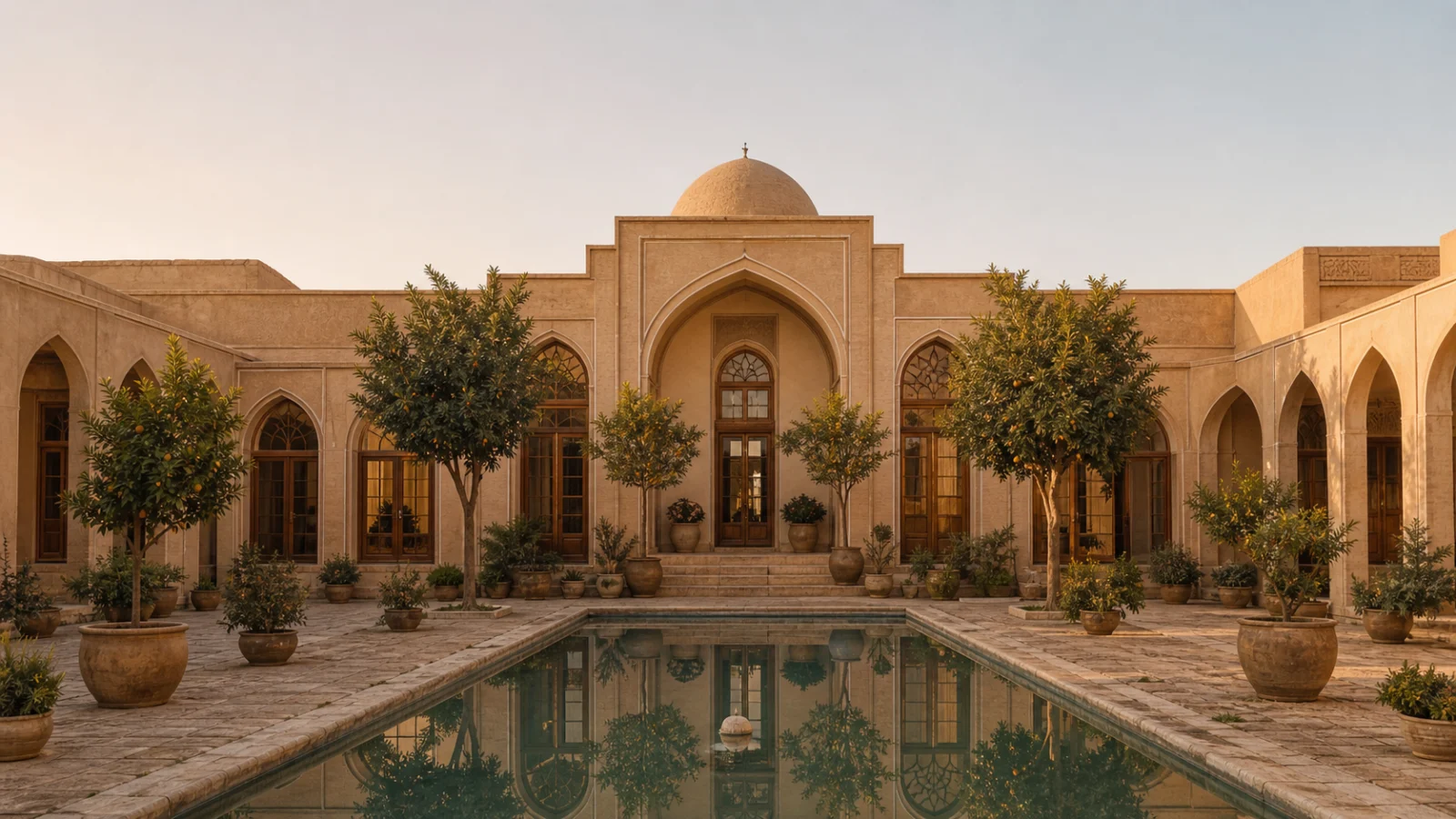
Many historic urban houses organise rooms around one or more courtyards. The courtyard can bring daylight, shade and a social centre to the plan. Rooms may differ in size, outlook and access because they were not originally designed as repeated hotel units. Ask about the exact room rather than assuming the website’s most dramatic photograph represents every room.
Adapted caravanserai
Caravanserais were roadside inns on travel routes. UNESCO’s description of the Persian Caravanserai World Heritage property notes that its 54 components show varied plans and materials developed for different climates. Some caravanserais have taken on new uses; an adapted stay should be assessed as both a hospitality operation and a conservation project.
New or substantially rebuilt property
A property can use brickwork, arches, coloured glass, textiles or courtyard planning without occupying a documented historic building. That is not automatically a disadvantage: a newer structure may offer more consistent access, services or room layouts. The important point is accuracy. “Traditional style” and “restored historic house” are different claims.
Neither old nor new is inherently better. Your choice depends on whether you value architectural atmosphere, predictable room features, accessibility, privacy, location or a balance of these. For a broader comparison process, begin with the main hotels in Iran planning guide before narrowing the search to historic stays.
How place shapes a traditional stay
Yazd: earthen architecture and climate response
Yazd is the clearest place to understand how a city’s built form responds to an arid climate. UNESCO’s official account of the Historic City of Yazd describes the use of earthen construction, courtyards, thick walls, qanats and wind-catchers. These elements are not hotel amenities by definition; they are parts of a wider living urban system. When a property highlights a wind-catcher or an earthen courtyard, ask whether the feature is original, restored or newly built and how the guest rooms themselves are ventilated and cooled today.
A central location inside or near the historic fabric may reduce transfer time to some sights, but old-city lanes can affect vehicle access and luggage handling. Confirm the final approach to the entrance, especially for a late arrival or limited mobility. Read the Iran travel guide alongside property information so the stay fits the city plan rather than becoming an isolated photo opportunity.
Kashan: houses adapted for contemporary use
Kashan is associated with courtyard residences whose sequences of entrances, halls, rooms and open spaces reflect privacy, season and household life. One documented adaptive-reuse example is Manouchehri House. The Aga Khan Award for Architecture included the project on its 2016 shortlist, and the property’s own website describes a former private residence adapted as a boutique hotel. Those sources support the project history; they do not establish today’s room availability, rate, service details or suitability for a particular guest. Those operational points must be checked separately and close to the intended stay.
Caravan routes and regional variation
UNESCO’s Persian Caravanserai listing demonstrates why a single visual stereotype is misleading. Materials, siting and layouts vary with climate and geography. A reused caravanserai may offer a powerful sense of enclosure and route history, but the distance from city services, transport arrangements and the treatment of the historic fabric are practical considerations. UNESCO’s 2025 World Heritage Committee decision also encouraged adaptive-reuse guidance that supports sustainable tourism while protecting integrity. In other words, good reuse is not just decoration; it involves ongoing choices about conservation and operation.
Traditional hotel or conventional hotel?
| Question | Traditional or adapted building | Conventional purpose-built hotel |
|---|---|---|
| Room consistency | Room size, light, stairs and outlook may vary substantially. | Room categories and circulation may be more standardised. |
| Atmosphere | Architecture and shared spaces may be central to the experience. | The building may prioritise predictable hospitality functions. |
| Accessibility | Historic thresholds, steps or narrow passages may remain. | Step-free routes may be easier to provide, but still require confirmation. |
| Privacy and sound | Courtyard-facing doors or windows can connect rooms to shared activity. | Corridor layouts may create greater separation, depending on construction. |
| Vehicle access | Historic lanes or protected areas can limit door-to-door access. | Road access and drop-off may be more direct. |
These are tendencies, not promises. A carefully adapted historic property may provide excellent accessibility and acoustic control; a modern property may not. The correct unit of comparison is the exact room, access route and service arrangement you are considering.
Questions worth asking before you decide
- Exact room: Which current photographs show the proposed room and bathroom?
- Access: How many steps are there from street to reception and from reception to the room? Is there a lift or a verified step-free route?
- Climate: What heating, cooling and ventilation serve that room during the intended month?
- Bathroom: Is it private and inside the room? Is the shower level or stepped?
- Courtyard: Does the room face a dining, event or reception area, and what are the usual quiet hours?
- Arrival: Can a vehicle reach the entrance? Who helps with luggage if the final approach is on foot?
- Operations: Which services and inclusions are current for the requested dates?
- Terms: What are the current cancellation, change and payment terms before confirmation?
How Persian Touring verifies a traditional-hotel request
A useful recommendation separates stable architectural context from changing operational facts. We use a source-led process and show the date of review because a beautiful historic description can remain accurate while the room inventory, access arrangements or services have changed.
- Identify the entity. Match the property name, city, address and official contact route so information from similarly named places is not mixed.
- Document the building claim. Look for a conservation record, recognised architecture source, official property history or other accountable evidence. If evidence only supports “traditional style,” we do not turn that into “historic.”
- Separate stable from changeable facts. Building form and documented project history can be relatively stable. Room availability, price, inclusions, access conditions and opening status require current confirmation.
- Check the exact room request. Dates, guest count, bedding, accessibility, bathroom needs, preferred location and any dietary requirements determine whether a property is a sensible match.
- Record source and review date. A recommendation should make clear what was checked, where it came from and when it was reviewed.
This method also helps detect weak listings. Warning signs include an unsupported construction date, identical wording copied across multiple sites, photographs without room labels, claims that every room has features shown only in public spaces, or an apparent booking offer without dated terms and a verifiable operator.
How to build a shortlist without relying on rankings
Start with your route and constraints, not a generic “top ten.” Choose the city nights in the context of your wider travel-to-Iran plan. Then decide what the building needs to do for you: provide a quiet room, place you in a historic district, offer step-free movement, accommodate a family configuration or make an early transfer practical. A famous courtyard is irrelevant if the exact room or arrival arrangement does not work.
Next, shortlist two or three properties that meet the non-negotiable requirements and compare like with like. Use the same dates, guest count, room configuration and questions for each. Ask for a written statement of the proposed room, included services, current terms and total quote before deciding. Avoid treating an old review, undated blog post or cached rate as present-day evidence.
If the traditional setting is the priority, allow time to experience the building rather than using it only as a place to sleep. If the trip has tightly timed transport, heavy luggage or accessibility requirements, weigh those needs just as seriously. Persian Touring can connect the stay to a private Iran journey or transfer request, but each element should be confirmed before it is presented as arranged.