Pars Hotel Kerman
Booking Pars Hotel Kerman with Persian Touring. Special price with discount. Start from 70$ per night
MORE

Booking Pars Hotel Kerman with Persian Touring. Special price with discount. Start from 70$ per night
MORE
Meymand is a village in Meymand Rural District, in the Central District of Shahr-e Babak County, Kerman Province, Iran. At the 2006 census, its population was 673, in 181 families.
Meymand is a very ancient village which is located near Shahr-e Babak city in Kerman Province, Iran. Meymand is believed to be a primary human residence in the Iranian Plateau, dating back to 12,000 years ago. Many of the residents live in the 350 hand-dug houses amid the rocks, some of which have been inhabited for as long as 3,000 years. Stone engravings nearly 10,000 years old are found around the village, and deposits of pottery nearly 6,000 years old attest to the long history of settlement at the village site.
Regarding the origin of these structures, two theories have been suggested: According to the first theory, this village was built by a group of the Aryan tribe about 800 to 700 years B.C. and at the same time with the Median era. It is possible that the cliff structures of Meymand were built for religious purposes. Worshippers of Mithras believe that the sun is invincible and this guided them to consider mountains as sacred. Hence the stone cutters and architects of Meymand have set their beliefs out in the construction of their dwellings. Based on the second theory the village dates back to the second or third century A.D. During the Arsacid era different tribes of southern Kerman migrated in different directions. These tribes found suitable places for living and settled in those areas by building their shelters which developed in time into the existing homes. The existence of a place known as the fortress of Meymand, near the village, in which more than 150 ossuaries (bone-receptacle) of the Sassanid period were found, strengthens this theory.
Living conditions in Meymand are harsh due to the aridity of the land and to high temperatures in summers and very cold winters. The local language contains many words from the ancient Sassanid and Pahlavi languages.
In 2005, Meymand was awarded the UNESCO-Greece Melina Mercouri International Prize for the Safeguarding and Management of Cultural Landscapes (about $20,000).
On 4 July 2015, the village was added to the UNESCO World Heritage Sites list.
MORE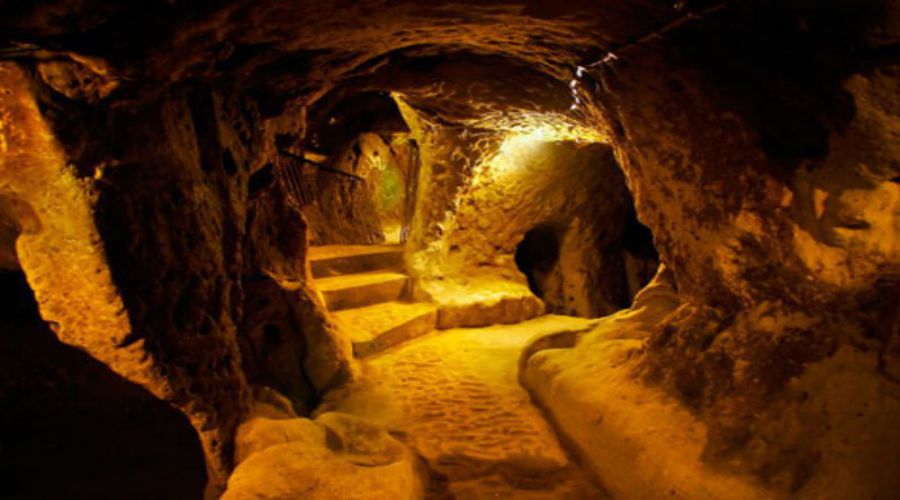
The Persian Qanat is a gently sloping underground channel with a series of vertical access shafts, used to transport water from an aquifer under a hill. Qanāts create a reliable supply of water for human settlements and irrigation in hot, arid, and semi-arid climates.
The qanat technology is known to have been developed in Iran by the Persian people sometime in the early 1st millennium BC and spread from there slowly westward and eastward.
The value of the qanat is directly related to the quality, volume, and regularity of the water flow. Much of the population of Iran and other arid countries in Asia and North Africa historically depended upon the water from qanats; the areas of population corresponded closely to the areas where qanats are possible. Although a qanat was expensive to construct, its long-term value to the community, and thereby to the group that invested in building and maintaining it, was substantial.
Qanats are constructed as a series of well-like vertical shafts, connected by gently sloping tunnels. Qanats tap into subterranean water in a manner that efficiently delivers large quantities of water to the surface without the need for pumping. The water drains by gravity, with the destination lower than the source, which is typically an upland aquifer. Qanats allow water to be transported over long distances in hot dry climates without loss of much of the water to evaporation.
The qanat should not be confused with the spring-flow tunnel, typical to the mountainous area around Jerusalem. Although there are similarities in the construction techniques (both are excavated tunnels designed to extract water from gravity flow), there are crucial differences between the two. Firstly, the origin of the qanat was a well that was turned into an artificial spring. In contrast, the origin of the spring-flow tunnel was the development of a natural spring to renew or increase flow following a recession of the water table. Secondly, shafts, which are essential to qanats, are not essential to spring-flow tunnels.
It is very common in the construction of a qanat for the water source to be found below ground at the foot of a range of foothills of mountains, where the water table is closest to the surface. From this point, the slope of the qanat is maintained closer to level than the surface above, until the water finally flows out of the qanat above ground,i.e., the qanat is an underground tunnel, beginning from an underground water source, with a gentle slope made in such a way that water is pulled by gravity to the surface (which is at a lower level than that of the underground water source). To reach an aquifer, qanats must often extend for long distances.
Qanats are sometimes split into an underground distribution network of smaller canals called Paris. Like qanats, these smaller canals are below ground to avoid contamination. In some cases, water from a qanat is stored in a reservoir, typically with night flow stored for daytime use. An ab Anbar is an example of a traditional qanat-fed reservoir for drinking water in Persian antiquity.
The qanat system has the advantage of being resistant to natural disasters such as earthquakes and floods, and to deliberate destruction in war. Furthermore, it is almost insensitive to the levels of precipitation, delivering a flow with only gradual variations from wet to dry years. From a sustainability perspective, Qanats use the force of gravity to surface up groundwater with no energy requirement and, thus, have low life cycle operation & maintenance costs once built. Qanats transfer fresh water from the mountain plateau to the lower lying plains that have a saltier soil. This helps to control the salinity of soil and prevent desertification.
MOREPersian Touring reservations
Enter the reference from your booking email.
Get Social